
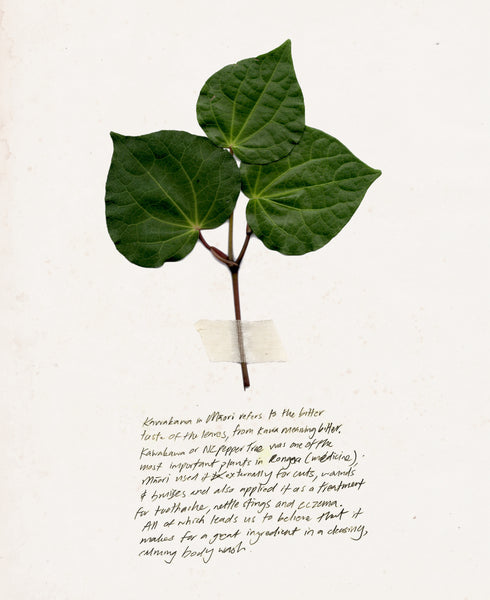
Growing up to six metres tall, branches are small and densely packed with resinous heart-shaped leaves ranging from dark green to yellow-green. Leaves are often marked with holes caused by the Kawakawa Looper Moth caterpillar (Cleora scriptaria). Plants are either male or female and both plants have small upright finger-like flower spikes, with female spikes ripening to dark orange in summer and producing sweet edible yellow-orange fruit.
Kawakawa contains myrsticin, a mild antiseptic and anesthetic
The presence of lignans in the smoke generated from burning kawakawa leaves and stems kills insects.
The Māori name 'Kawakawa' refers to the bitter taste of the plant. It was traditionally used for its medicinal purposes as part of an infusion of leaves and berries to treat ailments from toothaches to bladder infections to repairing or healing skin problems or repelling insects.You can place 3 leaves in a cup of boiled water and leave to infuse as a tea. Or burn dried leaves as an insect repellent.
Kawakawa is also sometimes used on marae where the leaves are waved during greetings, especially at a tangi or funerals, as well as worn as wreaths on the head by mourners.
Get the benefits of Kawakawa in Triumph & Disaster goods here:


Get the benefits of Kawakawa in Triumph & Disaster goods here:




Leave a comment
This site is protected by hCaptcha and the hCaptcha Privacy Policy and Terms of Service apply.